
Why the English and French versions of my website are not mirror copies
I launched Konyfer to help British companies enter the French market and French companies expand into the UK or other English-speaking markets.
My experience has taught me that the same products and services cannot be marketed in quite the same way in two different countries. I wanted a practical way to demonstrate that.
Then it struck me: my own website could do exactly that.
The website needed to be bilingual, with the same Konyfer services available in English and French. It also needed to reflect my new visual identity.
I rather like the little symbol: it suggests a conifer while also combining a stylised K and Y ^^.
From the outset, I wanted to keep the same building blocks from one language to the other. That did not mean presenting them in the same order. And translating the copy correctly would not be enough to create two convincing versions of the same website.
That became one of the guiding principles behind konyfer.com.
Different readers, different starting points
My business focuses on two core markets and two different Ideal Client Profiles.
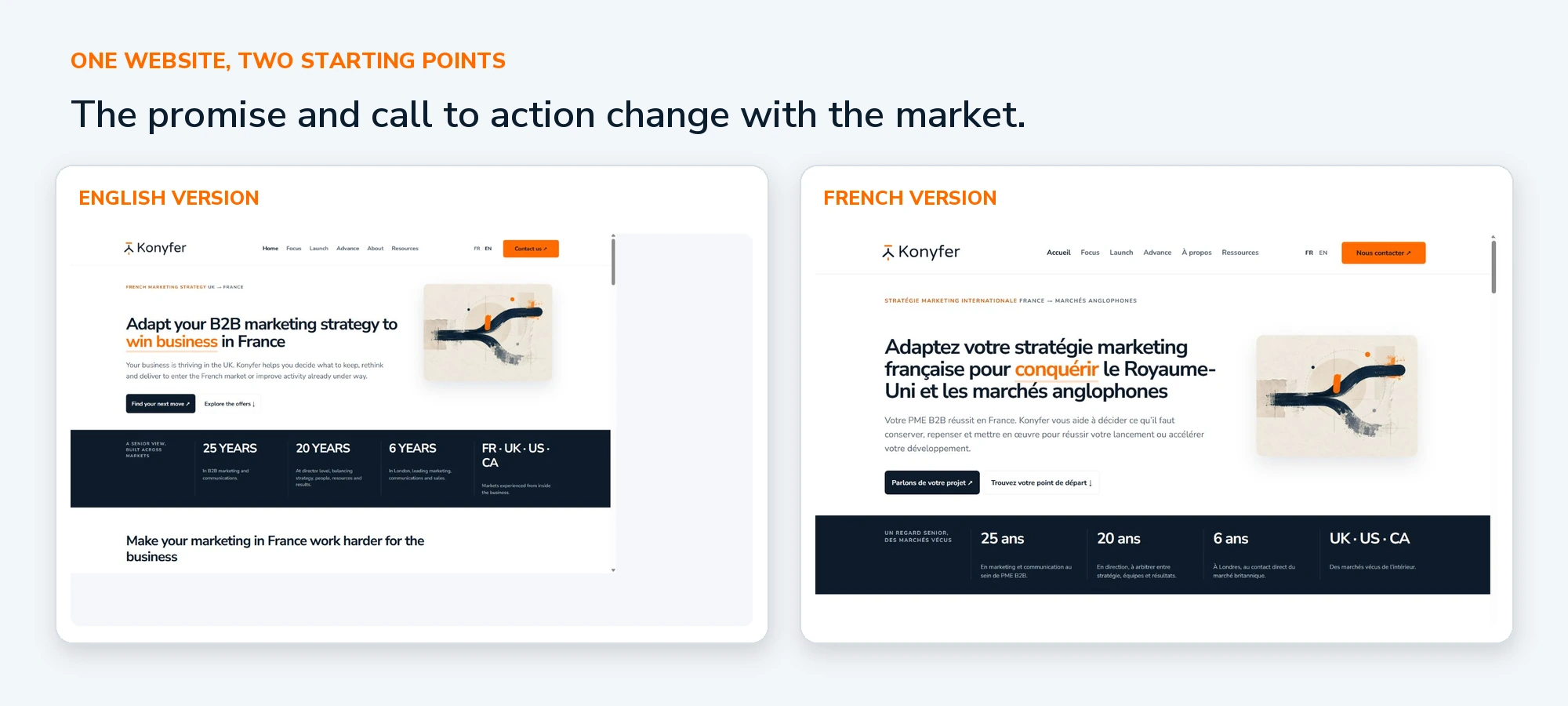
The English version is written for a British company looking to enter France.
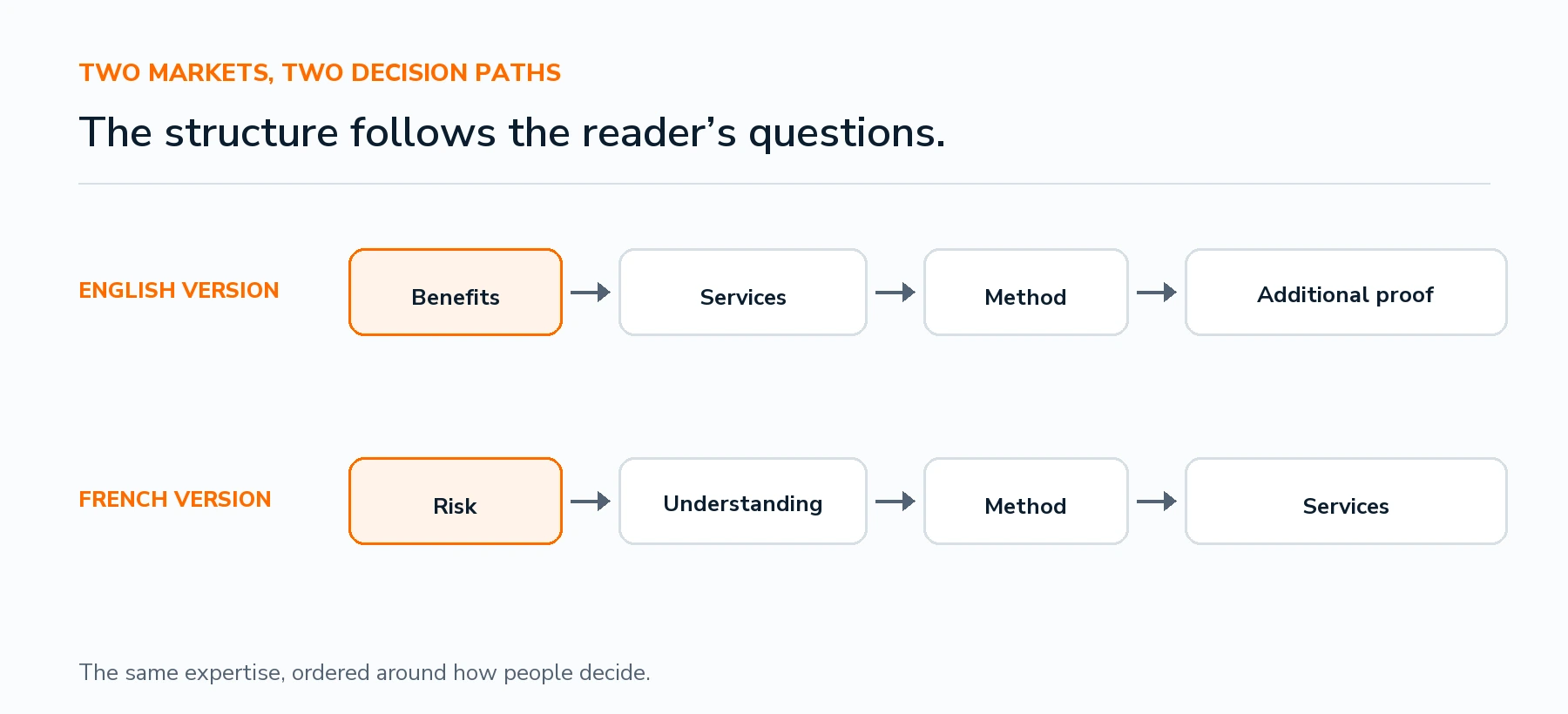
The British decision-maker I am speaking to usually wants to understand quite quickly what Konyfer can contribute. The English Home therefore starts with the expected outcome:
“Adapt your B2B marketing strategy to win business in France.”
It introduces value, commercial traction and better-targeted investment early in the page. The services also appear sooner.
The French version is written for a successful French SME considering the UK or another English-speaking market.
Its director first needs to see why a model that works well in France may still need to be challenged. They may not yet expect substantial adaptation to be necessary. Once that is clear, I can help them decide what to retain, what to adapt and which risks to avoid before investing.
To follow the questions a French decision-maker is likely to ask, the French Home begins by setting out the problem:
« Ce qui fonctionne en France ne se traduit pas en anglais. Il se repense. »
In other words: what works in France cannot simply be translated into English. It needs to be rethought.
The page then explores messages, evidence and the customer journey. It explains the Konyfer method before presenting the services.
I kept the same expertise and the same assignments. I changed the path offered to the reader.
Making my experience relevant
I also had to think about how to present my own background.
For a British company, my six years in London show that I understand the market from the inside. I worked there, led teams and dealt directly with British customers and business practices.
That matters, but it does not explain on its own why I am well placed to help a British company enter France.
The English version therefore makes something else clear: I am French, I work from France, and I understand the customers, companies and business habits it will encounter there.
For a French company, my 25 years in international roles and six years in London provide a different kind of reassurance.
My knowledge of the UK does not come only from market studies or projects managed from France. I lived and worked there, led teams and dealt directly with British customers and working practices.
The facts have not changed. Their order and their role in the argument have.
This is a good example of what can be lost in a mirror translation. A powerful piece of evidence in one market may become secondary in the other.
I also raise another question on both versions of the site: why use an experienced consultant in the age of AI? I will return to that in a future article.
The technology should not dictate the structure
I built the site on WordPress, a platform I already knew well after creating dozens of websites with it.
I also turned to a translation plugin I had used on a previous website available in eight languages. I did not translate all eight versions myself, but I was involved in integrating them.
The plugin connects a French page to its English version and allows the content to be translated segment by segment. This is very convenient when both pages have exactly the same structure.
It is also the easiest option: translate one line, then the next, perhaps with the help of artificial intelligence.
But that method naturally encourages you to reproduce the original page. A heading matches a heading, a paragraph matches a paragraph and a button matches a button.
The result may be a perfectly correct translation without being the best possible page for the target market.
To change the order of the arguments, move a piece of evidence or introduce a service earlier, I simply moved away from that line-by-line correspondence. The two pages remain connected in WordPress, but they can evolve separately.
It takes more work. I also have to check links, menus, forms, calls to action and the transitions between languages.
The tool manages the languages. It cannot decide what a British or French director needs to understand first.
One Konyfer.com with two distinct localised versions
The English and French versions of konyfer.com are still two versions of the same website. They share:
- the same visual identity;
- the same Focus, Launch and Advance services;
- the same durations and working principles;
- the same facts about my experience;
- the same objective: helping a business make better marketing decisions between the UK and France, or between France and another English-speaking market.
That consistency matters. Adapting a website does not mean changing the reality of the business depending on the country.
My job is to select the right arguments, the right evidence and the right order to make that reality easier to understand.
What I actually adapted between English and French
Between the English and French pages, I adapted:
- the promise expressed in the hero;
- the position of the benefits and services;
- the evidence used to create trust;
- some examples and points of attention;
- the amount of explanation devoted to the method;
- the calls to action.
Some of these differences are obvious. Others come down to a few words or the position of a single block.
Put it to the test
Switch between the English and French home pages.
Compare the headline, the first pieces of evidence, the order of the sections and the calls to action.
You will recognise the same company, but the argument unfolds differently.
That is deliberate.
An international website should not feel as though it was translated after the design work had been completed. Each version should make visitors feel that the company has considered their market, their expectations and the decision it is asking them to make.
Is your website translated or genuinely adapted?
If you are unsure whether a page, a piece of content or a stage in your customer journey will work for a British or French audience, Konyfer Focus can examine one clearly defined issue.